Unboxing experience design: the box no one throws away
the fifteen seconds that decide whether the box ends up in the trash or under the bed.
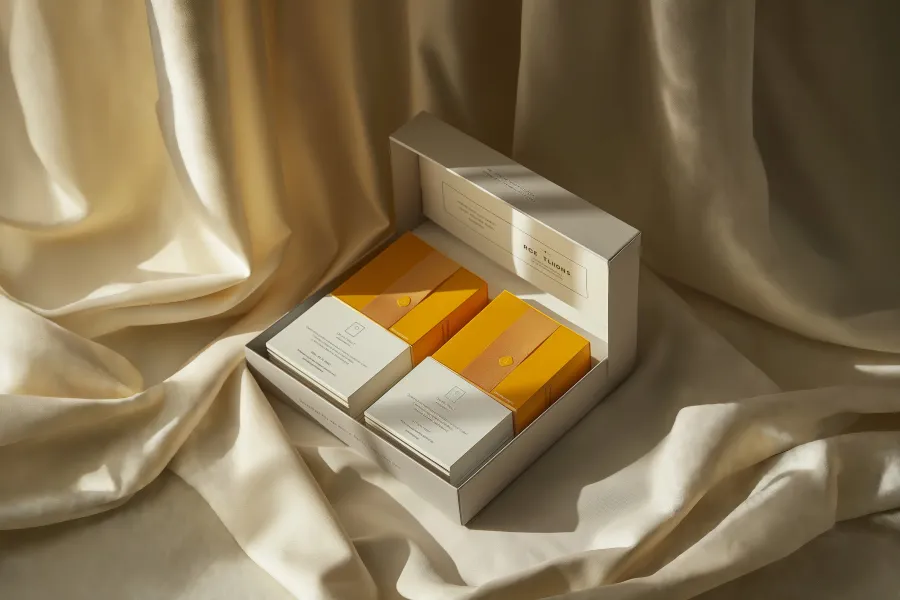
In almost every home there is a box that has never parted from its contents. It sits under a bed, on top of a wardrobe, inside another box. It is not especially beautiful in itself. Yet it entered the home through a precise gesture, and it never detached from that moment.
Unboxing experience design is the discipline that works on that gesture. Not on packaging — that is something else, an established craft dealing with cartons, dies, fillers, unit costs. Unboxing experience design focuses on the fifteen seconds between received and opened. Fifteen seconds in which the brand stops being an image on a product page and becomes a hand meeting a box, a resistance giving way, a scent escaping.
Fifteen seconds. They decide whether the box, afterwards, ends up in the bin or under the bed.
Unboxing experience design: what it means (and why it is not just packaging)
it is not the box. It is the film the box sets in motion.
The operational definition, stripped down: unboxing experience design shapes the seconds of opening as if they were a short scene.
Three elements tend to matter most when an unboxing experience works.
The opening architecture — how you enter the box, from which side, with which gesture. The choreography — in what order things appear, what is seen first, what is seen last. The tactile layer — how the box feels in the hand, how the tab slides, how a seal comes off.
Three components working together. If even one is off — a tab that tears awkwardly, the main product revealed too early instead of at the end, a weight that feels too light compared to perceived value — the experience collapses. The product remains. The promise does not.
Unboxing is a specific case of the silent work packaging does for a product — lthe difference is that here packaging is not working on a shelf, it is working in the customer’s home. It is a salesperson speaking in a living room, two weeks after the payment has already gone through.
The seconds that decide: the physiology of an opening
weight, sound, friction, scent, light.
The technical side of the mechanism is less mystical than it is often described. The perceptual sequence triggered when a hand meets a box is predictable — and it can be designed. Weight, sound, friction, scent, light — they enter the recipient’s mind in this order, before language. And before language, an opinion has already formed.
Until a few years ago, the packaging industry treated opening as a secondary detail — as if in cinema only the beginning of the film mattered. It was a world where openings were called flaps and no one spent more than half a day deciding them. The box arrived intact. That was enough.
Then YouTube happened. According to YouTube data via Smurfit Kappa (2024), videos with “unboxing” in the title exceeded 25 billion cumulative views in 2024. Twenty-five billion. The number does not describe a collective fascination with opening boxes; it describes a generation of buyers who decide what to purchase by watching someone else open the box.
At that point, the fifteen seconds stop being a detail. They become a point of sale — in fact, the point of sale.
What changes in e-commerce
the package is the first point of sale.
In e-commerce, the point of sale is not a shelf. It is a box that arrives at home. It is the moment when a brand, until then purely digital, becomes a physical object — with weight, material, friction, smell. Packaging design for e-commerce determines whether the promise made on the website matches the price paid. Or not.
The data is clear, and it all points in the same direction. The Dotcom Distribution Packaging Survey 2024 reports that 60% of consumers are more likely to share a purchase online when the packaging is creative or “fun to open”. The same organization, the previous year, measured the reverse effect: 60% of consumers say they are unlikely to repurchase from an online retailer that ships with poor packaging (Dotcom Distribution, 2023). Sixty percent on one side, sixty percent on the other. The box is symmetrical: it amplifies in both directions.
IIn Italy, some brands have understood this for a long time. Aspesi ships its parkas in fabric bags instead of plastic wrapping. Erbolario surrounds its packages with potpourri. Marvis delivers toothpaste in a box that resembles a jewellery case. These are artisan-like details rather than corporate ones. They increase unit cost, but they create a secondary product — the box itself — that customers keep.
For e-commerce companies packaging is not a logistics problem with a layer of aesthetics. It is an experience problem constrained by logistics. The difference, in terms of numbers, is significant.
Five ingredients of a box no one throws away
not rules, but observed patterns.
In packaging projects, there are recurring elements that tend to appear when a box enters a home and is not thrown away. They are not rules — they are patterns observed in practice. We list them not as laws, but as a repertoire.
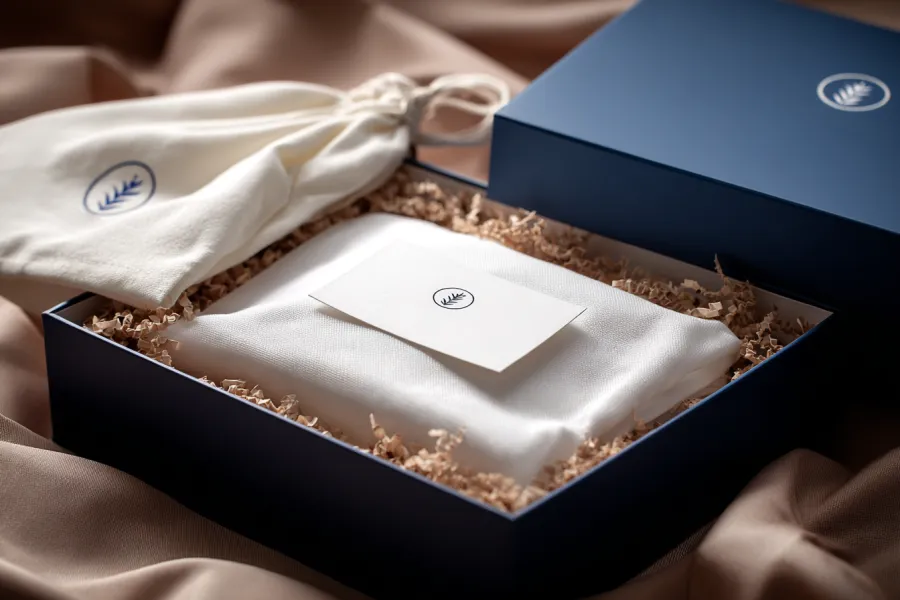
Modularity of filler materials. Tissue paper, paper nests, cotton pouches — not anonymous bubble wrap. They occupy space while also creating anticipation. The finger that touches tissue paper before the product is already engaging in the experience.
Hierarchy of opening. The main object appears last, never first. Above it are envelopes, notes, accessories, sometimes a bag inside a bag. It follows the same logic as cinema: the protagonist does not appear in the first minute, but after the world has been established.
Surface tactility. Premium packaging invests in tactile materials — soft-touch papers, coated textures, cotton-based stocks. They are expensive, but they measurably change perception. A Dotcom Distribution 2022 survey of 1,150 online shoppers found that 51% perceive brands using premium packaging as more upscale. The feel of the box does half the work the product would otherwise have to do alone.
A small unexpected gesture. A handwritten note, a postcard, a non-standard seal, a small treat. Nothing costly. It shifts the experience from commercial to personal.
A second layer of thought. A box-in-a-box structure, an internal textile wrap, a scent that surrounds the package itself. It is the detail the customer does not expect — and, when present, signals that someone designed the opening as a gesture, not a procedure.
Other elements could enhance the experience further. But these five recur often, and it is rare to see fewer than three when a box passes the “not thrown away” test.
Cost and return of well-done unboxing experience design
it appears in the income statement on the cost line, but it works on the revenue line.
Section, stripped down, because it is the most requested. How much does it cost to design a custom unboxing experience for an e-commerce business?
It depends on four variables, which are worth naming rather than reducing to a single figure. The production volume — a 500-unit custom packaging run costs far more per unit than a 50,000-unit run, nothing new there. Materials — a four-color offset microcorrugated box costs far less than premium carton packaging with gold foil and fabric pull tabs. Opening complexity — a single-flap box costs a fraction of a structure with double openings, internal dividers, and box-in-a-box systems. Customization — ua neutral package is worth less than one with a customer-specific printed note.
In terms of return, the numbers are more stable. Smithers,"The Future of Global Packaging to 2028", (2023) reports that the paperboard segment — the core of premium e-commerce packaging — is growing at a 4.2% CAGR through 2028, driven in Europe by e-commerce and sustainable alternatives to plastic packaging. In other words, demand for packaging that communicates meaning is growing faster than the overall market.
Return for a single brand can be measured along three dimensions. Repeat purchase rate. A memorable box creates a buffer against the next imperfection in the product: the following delivery may be late, but the customer still feels valued. Organic sharing. When 60% of consumers say they want to share a “fun to open” package, the box becomes advertising the customer pays for, not the brand. Price tolerance. A product delivered in a jewellery-like box can command 15–20% more than the same product in a standard padded envelope.
Three directions that, combined, lead to a single point: premium packaging is not a logistics expense. It is a brand investment. It sits on the cost line in the income statement, but it works on the revenue line.
Frequently asked questions about unboxing experience design
What is unboxing experience design, and how is it different from traditional packaging?
Unboxing experience design shapes the seconds between when a customer receives a product and when they first see it in their hands. It works across three dimensions — the architecture of opening, the choreography of reveal, and the tactile quality of surfaces — rather than focusing only on protecting the contents. Traditional packaging answers the question: how does the product arrive intact at its destination? Unboxing experience design answers a different question: how does the customer behave in the fifteen seconds between receiving and opening? It is a difference in objective, not in technique: the same materials can be used, but the design sequence is reversed.
How much does it cost to design an unboxing experience for a premium e-commerce?
It depends on four variables: production volume (below 500 units, unit costs are high), chosen materials (specialty papers, foil stamping, internal textiles), opening complexity (number of layers, box-in-a-box systems, internal dividers), and level of personalization (customer-specific printed notes, custom seals). For a premium Italian DTC e-commerce, packaging is typically treated as an investment spread over two to three years of seasonal cycles. The exact figure is best defined at brief stage — constraints vary too much from project to project for a generic range to be meaningful.
Which Italian brands do unboxing experience well?
Among visible examples: Aspesi ships its parkas in fabric bags instead of plastic; Slowear uses dark cardboard boxes with fabric pull tabs; Marvis delivers toothpaste in boxes that resemble jewellery cases; Loro Piana treats the box as a continuation of the product itself; Aboca, in the herbal sector, ships packaging that feels like editorial booklets. These are all brands that have understood that in DTC e-commerce, the box is the first physical point of sale — and they design it accordingly.
Does unboxing experience also work for mid-range products, or only for premium ones?
It works especially well in the mid-premium segment — the range where a product needs to justify a price premium compared to direct competitors. A clearly low-cost product in premium packaging creates dissonance (the customer perceives waste). A luxury product already carries other signals of value, so unboxing adds relatively little. The point of maximum effectiveness is mid-premium: artisanal wine, independent cosmetics, specialty food, refined apparel. In this space, the box convinces the customer that the price they paid was justified.
Anyone who has read this far has probably already thought about their own product and its box. About how the package arrives. About what the customer sees first. About whether the box ends up in the trash after opening, or remains somewhere in the house.
If you want to understand what the unboxing experience of your product could become, the starting point is an external look at the packaging. Not a quote: a conversation. Three precise questions: What happens between received and opened? Who are the three or four reference brands for your customer, and how do they deliver? What does the customer say about the first opening — if they say anything at all?